
You want articles your potential customers find relevant and that create trust, that help you promote your product, and you can measure the impact in revenue. Needless to say, youw want results in weeks, not nine months. That's what technical content marketing agencies are for.
We researched 43 of them and talked to some over a call. Here's what you should know about them.
Why Hire Technical Content Marketing Agencies?
Your posts need someone who understands the subject well enough to explain it accurately, but that person is often an engineer. Well over half of technology marketers outsource some of their content, but 75% say finding a partner with enough topical expertise is their biggest problem.
Subject matter experts are tough to reach for 41% of tech marketers, and yours are your engineers, whose time is already going toward the roadmap.
Hiring for that isn't much easier. Clerk's CEO calls developer marketing "a very hard role to hire for", largely because "most people don't understand developers".
Community writers can help, but a writing program called its writers "good, but there's a glass ceiling in terms of coding ability". They may understand your audience without having enough depth to explain every subject accurately.
Then what about the articles that sound right but aren't? DevRels describe checking content themselves for confident mistakes, because a developer audience will catch it immediately and it destroys credibility fast.
That's what a technical content marketing agency solves: someone who understands the subject deeply enough to write about it accurately, without making your engineers responsible for producing every piece. You get the technical depth, writing quality, and search expertise in one team, already trained.
When to Hire a Technical Content Marketing Agency
Any one of these is enough to go looking for an agency.
SEO is working and you can't publish any faster:
Most content teams are two to five people, and about a fifth are just one. Demand goes up. Capacity doesn't.
Ranking now takes writing, technical depth and AI answers at once:
Knowing what ChatGPT and Claude cite is now part of what it takes to drive results, and that's even another additional task. That helps explain why outsourcing is experiencing a budget increase of 20% in technology marketers in 2026, against 9% for salaries and training.
You need an acquisition channel that reaches developers:
Deeply technical content on the company blog had the highest impact, according to a founder who had tried contract writers and agencies. Yet the last of those are "probably overkill" before product-market fit, in his words.
No article on your blog has revenue linked to it:
62% of technology marketers call attributing ROI their most common measurement difficulty, and just over half call it a challenge to create content that prompts a reader to act.
What Should I Look For When Choosing Technical Content Marketing Agencies?
Ask these questions to the technical content marketing agencies you talk to.
"Can I See Two or Three Articles Closest to Our Product?"
What you need is content the developers, engineers or security analysts using your product would trust. Read the articles as they would.
Case studies alone might not be enough. One team hired an agency because of that, and fired them after six months and $45k wasted. The reason? "Bland marketing speak".
You should ask for two or three articles for a product like yours, with code snippets that run if there are any, and a straight account of who did what in the overall process.
For example, in our experience interviewing hundreds of technical writers, we found that most freelance articles go through a heavy internal editing process. So the published article you see online is very different from what was delivered.
"Who Will Actually Work for Us?"
We learned the hard way: agencies show you the face of senior people in beautiful slides but then all the work is delivered by juniors.
"How Much of Our Engineers' Time Will You Need?"
Among the agencies here, the lightest client role is a kickoff call, a quarterly roadmap and occasional feedback. The heaviest is approving every outline or peer-reviewing everything.
Then ask who on their side checks each draft for accuracy before your engineers see it: a second technical writer, a technical reviewer, a developer and an editor... or generic content marketers using AI. Otherwise, that job falls to your engineers' shoulders.
It's normal that at the beginning you need to dedicate a bit more time, but that should quickly decrease or it's a red flag. For example, we talked to a devtool CMO who complained that he's repeating the same feedback over and over again and that his writers, who were barely learning from mistakes. That was causing him to waste time instead of being able to focus enough on some other initiatives he needed to work on.
"What Did Their Content Earn Their Clients?"
Two people on r/SaaS who fired their agencies say their reports showed "engagement" without connecting to revenue, or explained why results hadn't come yet.
A traffic figure counts visitors, not customers. Meanwhile, where are the qualified leads, closed pipeline deals, and revenue figures?
The Best Technical Content Marketing Agencies
The agencies below are split by the field they serve, then by who writes the piece, by how they learn your product, and by what their published results were measured in: traffic, signups/leads or revenue.
1. Nakora: When You Measure Content in Revenue
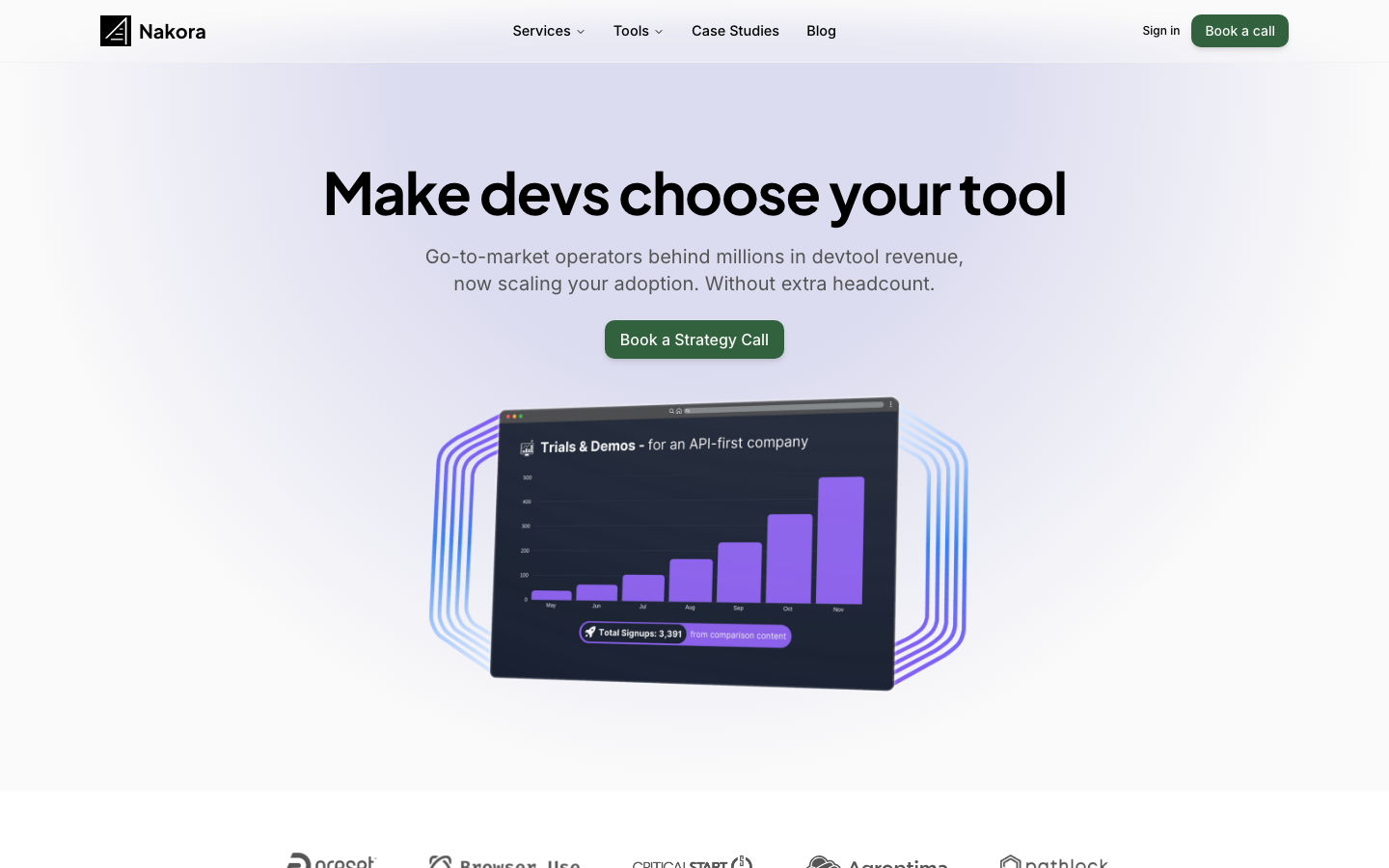
Nakora is a technical content marketing agency primarily for B2B SaaS companies whose audience is engineers and other specialized roles.
Its report results in revenue, trained its team over 3+ years, and have qualified technical writers. It focuses on high-intent content, such as tutorials, comparison articles and landing pages. It's also able to identify what content to create first to get results faster.
Nakora has experience in many verticals, but some to highlight are devtools, analytics, and AI.
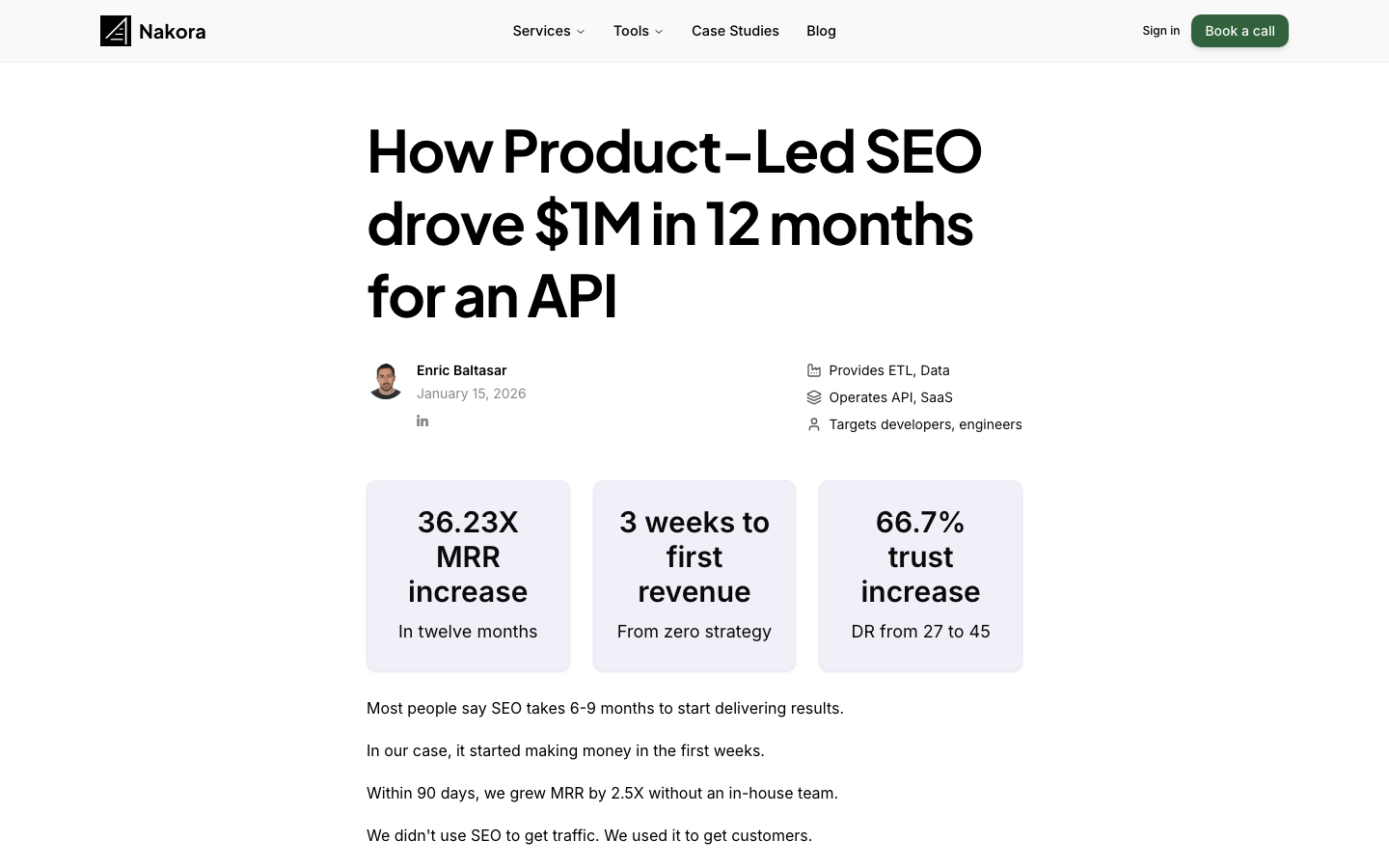
Here's an example: For an API, product-led SEO took the company to $1M in annual recurring revenue in 12 months.
Pros
- Tutorials on how to solve problems: Reach developers searching for how to solve a problem with open-source tools, on topics where the popular solution is likely to break, and send those developers to your product.
- Programmatic SEO from what customers ask: Turn questions from support conversations and product usage data into template-built landing pages. That method is behind $129k in revenue in three months for a PLG SaaS.
- AI search to be recommended in LLMs: The team doing your SEO finds the prompts developers give ChatGPT, Claude, Perplexity and Gemini, then reworks your core content so those assistants prioritize citing it and mentioning your brand.
- Analytics reporting: See each piece judged on signups and revenue as well as traffic, with the full funnel tracked from the start.
- Early results before expansion: Get quick wins executed first, then a playbook once they prove to work, then scale. Nakora calls that order its Seed-Grow-Scale framework.
Cons
- Accept few clients: They only accepts companies that have proven product-market fit, have a competitive advantage and are able to get big results from the services provided.
- Not the cheapest option: They focus on providing high-quality content and ROI.
Pricing
Nakora doesn't publish a price for its services, but most of its regular partners pay at least $7k per month, or higher for its end-to-end service (SEO strategy, keyword research, content calendar, content writing, multi-format with landing pages, product activation increase, CRO, attribution).
2. Infrasity: If You're an AI Agent or Infra Startup
Infrasity targets devtools and early-stage SaaS startups, where AI agent startups and observability platforms are its main focus. The content is written by an engineer who uses your product first, as with Firefly's workflows in AWS, Azure and Kubernetes.
A case study says Firefly.ai's organic traffic rose 781% over 18 months, and its signups grew 44.19% in one month.
Pros
- Demo code: Get demo repositories for your product in its public GitHub organization, like the ones for MemClaw.
- Republishing beyond your own domain: Have your articles republished on Medium, dev.to and daily.dev. Nine of Qodo's were.
Cons
- Occasional late delivery: A Cerbos manager's on Clutch says the team "was often delayed in delivering their work".
Pricing
Infrasity puts no price on its website, and in September 2026 its Clutch profile lists a $5,000 minimum project.
Its Starter plan gets you four long-form technical posts and one SDK guide or integration walkthrough a month. You can start it with a 30-day proof of concept.
3. Draft.dev: If You Need Engineer-Written Posts at Volume
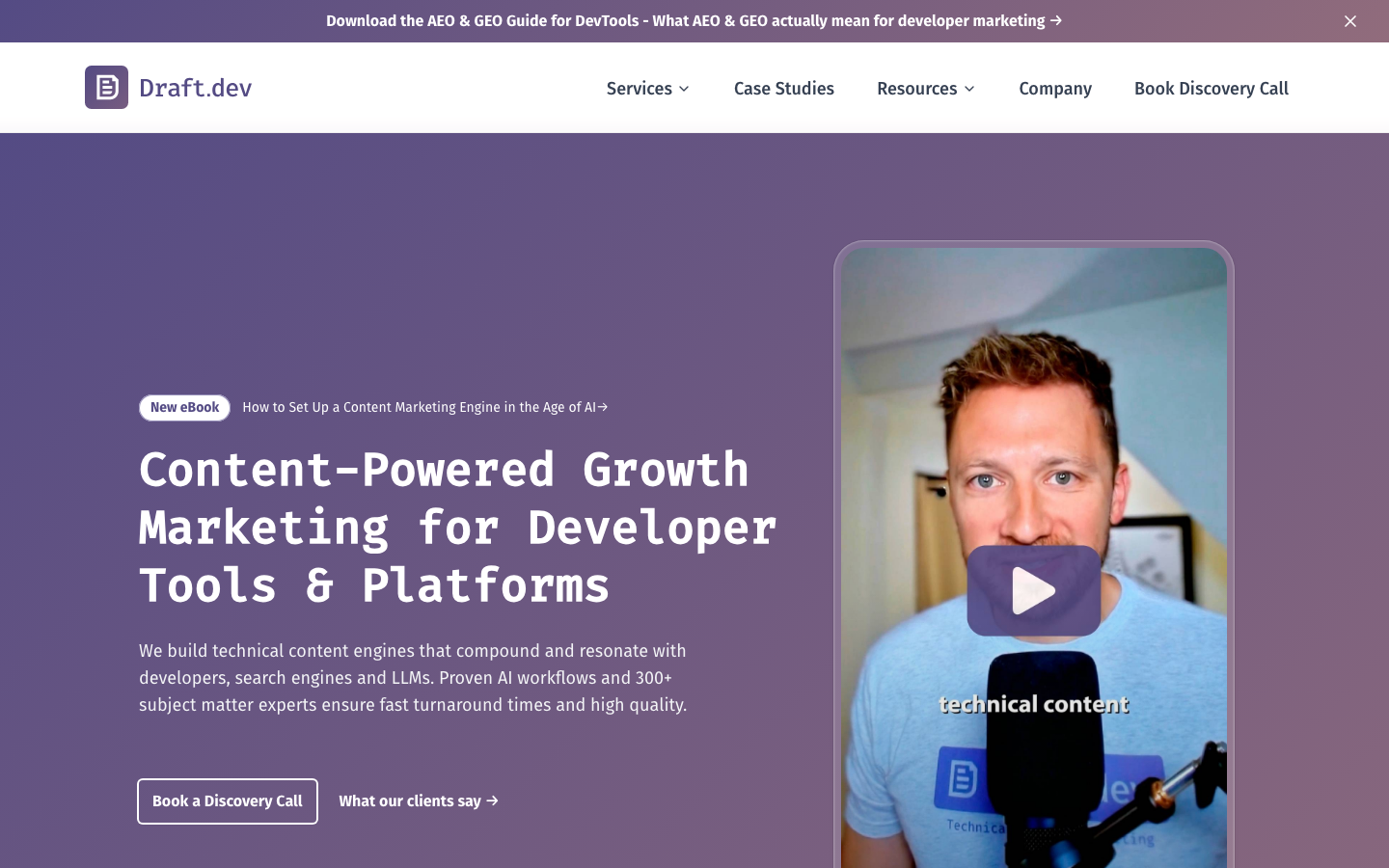
Draft.dev describes itself as "Content-Powered Growth Marketing for Developer Tools & Platforms", and its founder says it typically waits until a client reaches Series A and strong customer adoption. A network of 300-plus vetted engineer-writers produces the tutorials, guides and comparison pages. They use AI to speed up research and drafting rather, and an editor lightly checks every article.
It delivered 3,000 pieces for over 100 clients, and its Loft Labs case study shows blog traffic grew over 4x in a year.
Pros
- Samples from 40 clients: Read tutorials and comparisons it wrote for JetBrains TeamCity, Snyk, Redpanda Data and Tailscale, all listed on its examples page.
- Publishing handled for you: Get finished articles published into your CMS with their social posts, while in most engagements your team attends a kickoff, approves a quarterly roadmap and gives occasional feedback.
- Cost per lead in the monthly report: Capture MQLs and SQLs through gated downloads with its landing page copy, and review the analytics with it every month.
- Promotion past your own blog: Have your articles pushed on Reddit, LinkedIn and X, rewritten for syndication and placed in niche developer newsletters.
Cons
- Several contractors per engagement: Its writers are practicing engineers, most with day jobs, so you'll likely work with several over time, and article order can shift with their availability.
Pricing
Draft.dev doesn't write trial articles. As of September 2026, plans start at $9,000 a month with a three-month minimum, which makes $27,000 the smallest commitment. That starting price went from $8,000 to $9,000 in February 2026.
It recommends promotional campaigns on top of the content, and paid media placement is a service of its own.
4. Hackmamba: Community Distribution on Reddit and Dev.to
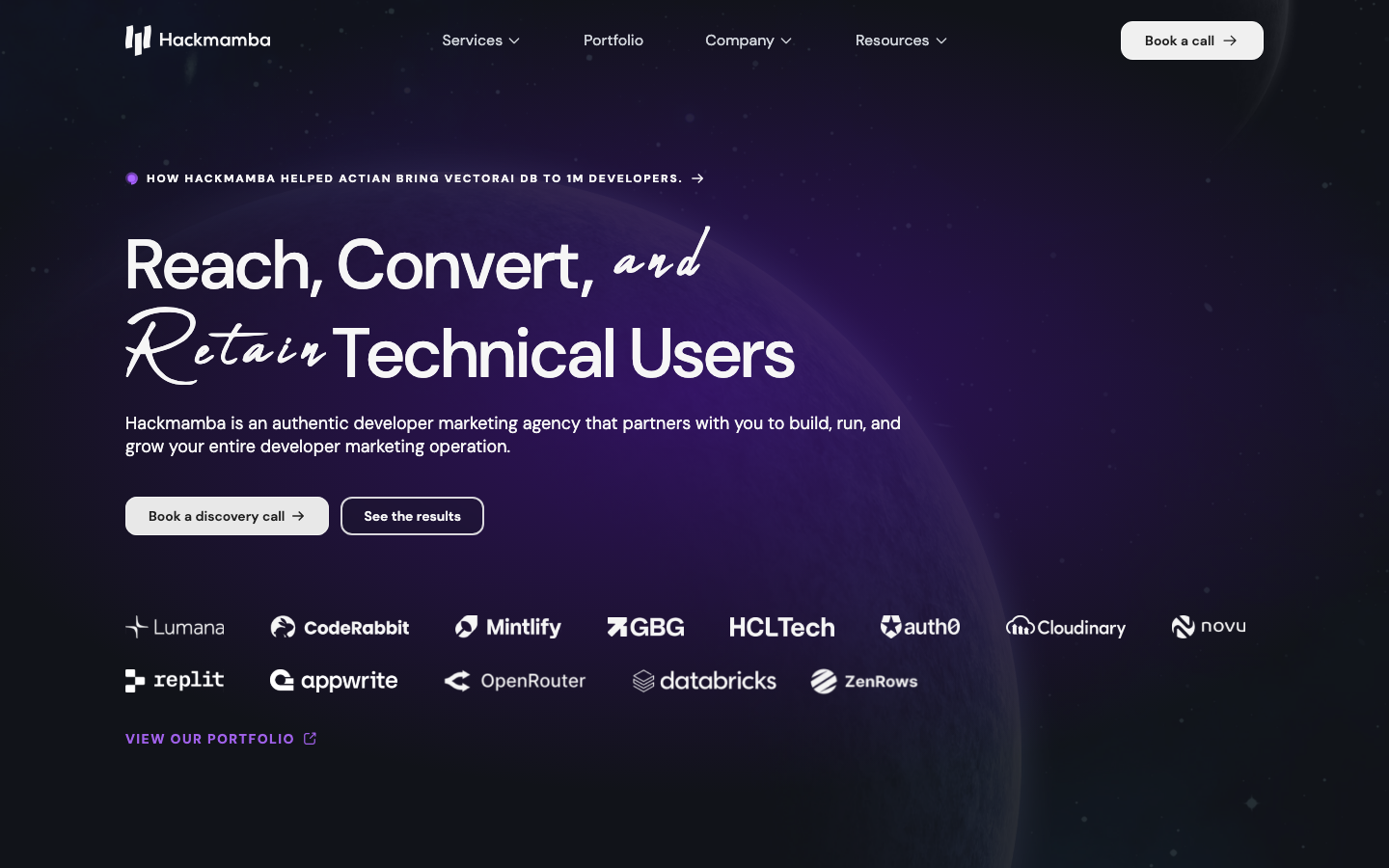
Hackmamba is a developer marketing agency that builds, runs and grows your whole developer marketing operation. In April 2026 it widened from content to six disciplines. From a network of contractors indexed by the technologies they know, it matches each piece to a writer who has worked in your stack.
AI builds each outline, a human rewrites every section, and an AI agent does the first technical review before a content marketer tests the code. Hackmamba's articles give the answer up front, with schema markup for AI search. Hackmamba reports Cloudinary's organic traffic grew from 281,000 to 529,000 monthly visits in five months, alongside 34 qualified developer signups a month.
Pros
- Distribution in developer communities: Get each article posted on Reddit, Hacker News, DEV, Hashnode and LinkedIn, and pushed to its Discord and to newsletters.
- Feedback in its own platform: Comment on every draft in Boki, its content platform, where the author answers within 24 hours.
- One person embedded in your team: Bring a dedicated technical writer into your meetings, with at least four hours of time-zone overlap.
Cons
- No revenue showcased: None of its case studies mention a business result.
Pricing
In September 2026, Hackmamba's content retainer starts at $2,500 a month, which gets you two to four technical posts. There's no lock-in.
Its own roundups of agencies, from May and July 2026, price the full program, which adds strategy, SEO and GEO, from $8,000 a month. The May one prices an article at $700 to $900.
5. Wizard on Demand: For Devtools Articles Built From Interviews
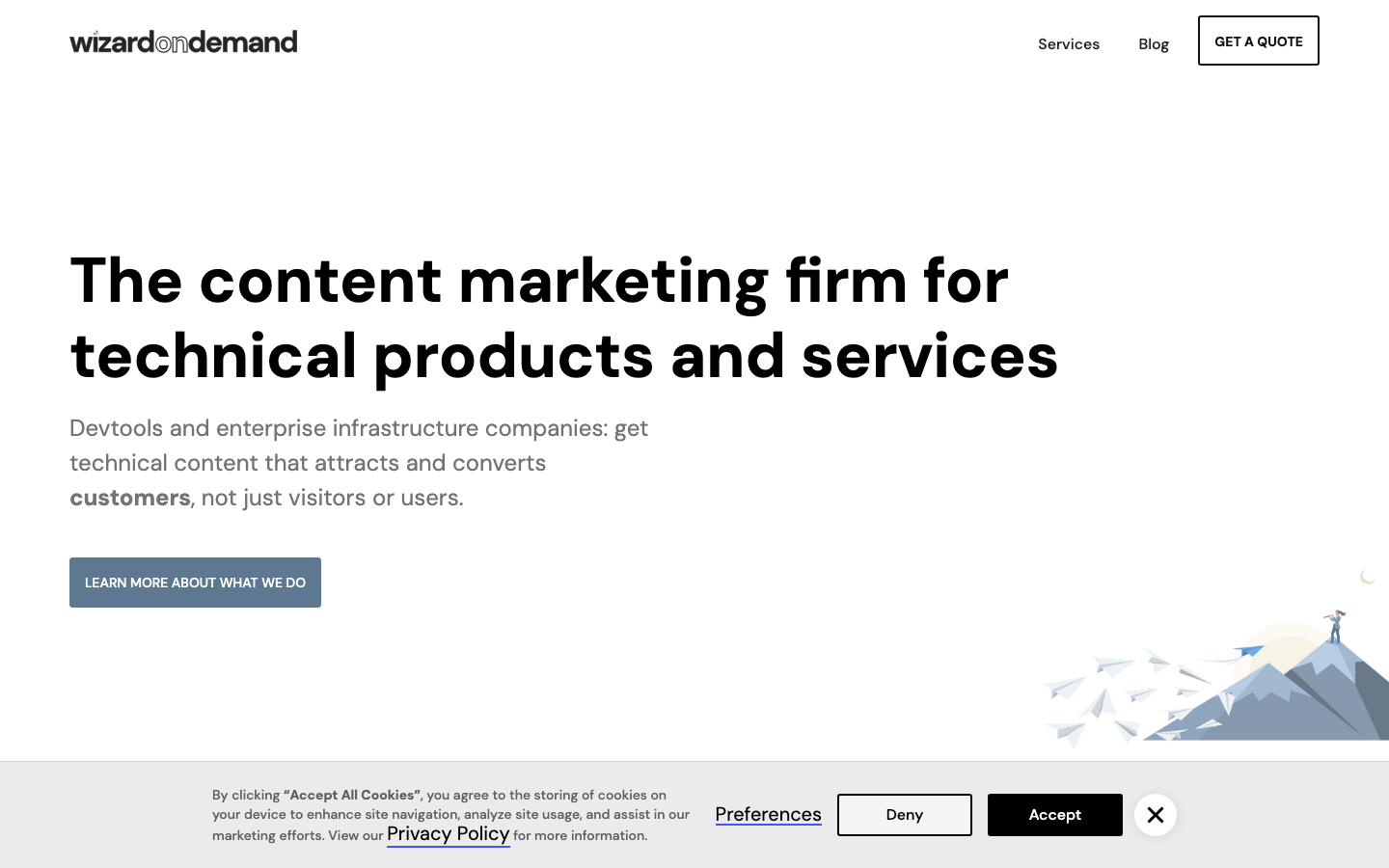
Wizard on Demand is for devtools and enterprise infrastructure companies, and it learns your platform from interviews with your executives, employees and end users, then drafts without the client in the room, and comes back with content ready for feedback. It lists GEO among its channels, beside SEO, social media and paid ads.
It hires part-time freelancers who have worked as developers or hold a master's degree in the field, and every article gets a code example built first, a peer review, and a technical edit. One of its results includes organic visit growth for deepset's by about 800%, and GitHub stars up 400%.
Pros
- Ads from the team that wrote the article: Have the agency behind your articles run your ads on Google, Microsoft, X, Reddit and LinkedIn, with creative from its own designers.
- A bylined sample on a client's blog: Read "What Is Text Vectorization?", published on deepset's blog in December 2021 by one of Wizard on Demand's technical writers.
- Coaching for your technical leaders: Get your CEO, CTO or VP of Engineering coached to write under their own name.
- A site restructure as a standalone job: Have it reorganize a website that grew without a plan, and keep the recommendations whether or not you use its other services.
Cons
- One client in each market: It won't work for two companies in direct competition, so if a rival already works with it, you can't hire it.
Pricing
Wizard on Demand publishes no price as of September 2026, and a 2021 post still on its blog says its content work comes only as a recurring subscription.
6. Argot: AI and SDK Tutorials With Working Code
Argot is for developer tools and AI products, and a typical job is a sample app built with your SDK, then written up as a tutorial, how-to or explainer. It recruits "developers who can write" who have shipped code.
Its blog argues that search and AI answers reward content made for people: "Prioritize the human, the machine will follow". The only results on record measure attention: Deno's "You Don't Need a Build Step", which Argot says it wrote or edited, drew 328 points and 210 comments on Hacker News.
Pros
- Code beside the tutorial: Get the full build in a public repository your developers can clone, as with Neon's AWS Lambda post and Stream's multi-model chat app.
- Clients that keep returning: Read 11 Retool posts under its writer's name, from June 2024 to February 2026, plus nine at Neon and eight at Hex.
- Head-to-head comparisons anyone can rerun: Get your product measured against rivals, and the method written up with it, as Nyckel's image classification benchmark was.
- AI work in its portfolio: Of the 44 client pieces linked to it, at least 16 are on building with or testing AI models.
Cons
- No distribution or AI search service: Its process ends at "You review, we revise, and you publish", so promotion is on you.
Pricing
As of September 2026, Argot gives no price.
7. GTM Delta: For Storage, Cloud and Infrastructure Vendors
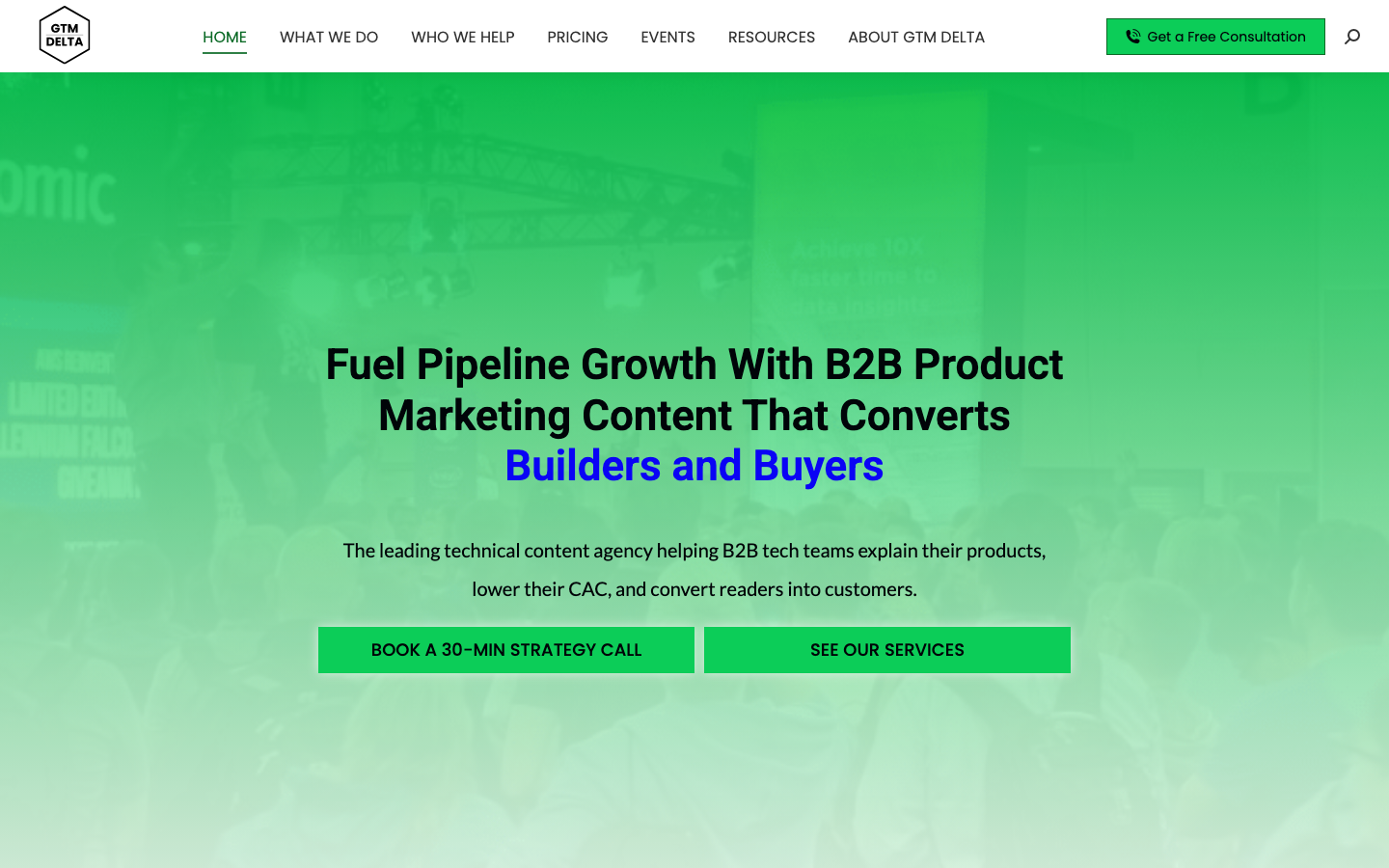
GTM Delta makes technical content for B2B tech teams, and its listed clients are storage and cloud vendors such as Pure Storage, Backblaze and Silk. It describes its contributors as "deep-tech content engineers (PhDs, architects, practitioners)", freelancers who need neither writing experience nor fluent English. That's because its reviewers finish each piece.
It interviews staff from your product, executive and marketing teams before a word is written, and it says its content is optimized for SEO and AI search. Its one client-named result is a quote on its site: Silk's Chief Business Officer says lead quality "drastically improved", with no number, no timeframe and no measure.
Pros
- A 27-page sample you can download: Read Silk's whitepaper for DBAs, cloud database engineers and SREs.
- Leadership from infrastructure: Work with an agency whose Executive Chairman spent nine years as R&D tech lead for VMware DRS, and whose Chief Content Officer was a Turbonomic solutions engineer.
- Media coverage from its own shows: Get a DiscoPosse Podcast feature, short video clips and a TechForward article around a launch or a conference such as NVIDIA GTC.
Pricing
In September 2026, GTM Delta's Flexible Content Engineering Program costs $7,500 a month on a three-month minimum, which is $22,500 at list price.
It delivers one piece at a time from a backlog of any length, and it doesn't say how many that makes in a month.
Its media packages need no retainer and cost from $2,500 one-time. You get up to 20% off the program with a platform partner's marketing development funds.
8. Bora: Long-Running Security Blogs and Thought Leadership
Bora works only with cybersecurity companies, on what it calls "AI visibility, demand generation, & thought leadership content", and its team is security writers and journalists. It ran Tripwire's State of Security blog for 11 years from 2014. Its Tripwire case study says that blog grew to about 300,000 page views a month.
For AI search, its Tenable case gives the credit to its own opinion pieces, placed in established publications. Work starts with questions and subject-matter expert interviews. You meet the people who'll do it.
Pros
- A published AI policy: Keep a human on strategy, thought leadership, fact-checking and every final sign-off, while AI takes on routine tasks and drafts the starting points that Bora reworks.
- Social media from the same agency: Give your company's social accounts to the people behind your blog, as it does for Fortra.
Cons
- No tutorials among its formats: Its services run from whitepapers and long-reads to webinar scripts and ad copy.
Pricing
Bora's engagements start at $4,000 a month or $10,000 a project as of September 2026, and it names no minimum term and no volume for either.
9. Content Visit: For Early-Stage Cybersecurity Companies
Content Visit does content marketing for security companies with "lean marketing, brand, and product teams", and it typically works with security startups heading to market and vendors with a marketing staff of one or two. Its co-founder has more than 10 years in cybersecurity marketing, and a tech journalist who's also a science communicator works with her.
Its AI search work covers indexing on Bing and Google, matching fan-out queries, and using rich media such as comparison tables. Content Visit reports that an unnamed threat detection platform went from 77 ranking keywords to 808 between early 2022 and mid-2023. It says one bottom-of-funnel post turns 0.5% of its visitors into leads and demo downloads.
Pros
- Current security statistics on hand: Get content built on figures from vendor and regulator reports, held in a database it keeps with a cybersecurity researcher.
- Accuracy checked with your CTO: Have your experts and customers interviewed, and drafts reviewed in ongoing talks with your CTO, as Morphisec did across more than 100 pieces.
- Published work you can open: Read DeleteMe's executive privacy guide, updated in July 2026, which Content Visit's DeleteMe case study links as its own work.
- A content audit after an acquisition: Get every existing asset scored for what's worth keeping, as Randori's several hundred were after IBM acquired Randori.
Cons
- A hard cap on clients: It takes no more than six at a time and doesn't outsource to unknown third parties.
Pricing
In September 2026, Content Visit's retainers begin at $3,000 a month, and its copywriting at $1,000 a month. An example package pairs three pieces of content a month with SEO work for $2,000.
In a 2023 post it says that it charges no set-up fee, that it doesn't lock you in, and that its average contract runs past two and a half years.
10. HackerContent: When Your Readers Are Hackers or AppSec Developers

HackerContent is only for cybersecurity companies. It says security engineers and pentesters write its blog posts. Its method is a 30-minute recorded interview with your subject-matter expert, a draft from the transcript and an accuracy check by the person interviewed.
For AI search it offers GEO through its inquiry form, and its own guide says nobody can honestly promise a fixed position in an AI answer. The figures on its home page are first-month averages across the X accounts it runs, among them 14x impressions, so they measure social reach.
Pros
- A showcase of 84 samples: Read posts it wrote for Detectify Labs, ProjectDiscovery and SpiderFoot, most of them hands-on walkthroughs of the tools hackers use.
- Practitioners whose names you can check.
- Training content for developers: Get security lessons like the 13 it made for Snyk Learn, which Snyk's testimonial calls "extremely accurate".
- Posts and social from one agency: It manages your social accounts and your SEO, and it repurposes your posts and pushes them out on those channels.
Cons
- No result from the writing itself: It publishes no traffic, ranking, lead or revenue figure.
Pricing
In September 2026, blog posts, whitepapers and landing pages come only inside a custom multi-channel retainer with no published price.
Social media management is the only service it prices: from $2,000 a month for one channel, up to about $6,000 for the most advanced single-channel packages. It offers to start with a small trial before anything bigger.
Technical Content Marketing Agencies Compared
The prices below are what each agency publishes on its own site, and the writers are as it describes them, as of September 2026.
| Agency | Best for | Pricing | Writers |
|---|---|---|---|
| Nakora | Content measured in revenue | Case by case, but typically from $7,000 | Its own trained writers and a technical writer pool |
| Infrasity | Early-stage devtools and AI agent startups | From $5,000 | In-house engineers |
| Draft.dev | Engineer-written tutorials at volume | From $9,000 a month, three-month minimum | A network of practicing engineers |
| Hackmamba | Developer content with community distribution | From $2,500 a month for two to four posts | Contract writers who've worked in your stack |
| Wizard on Demand | Devtools and infrastructure content built from interviews | Not published | Part-time freelancers who worked as developers or hold a master's |
| Argot | Tutorials for devtools and AI products | Not published | Developers who've shipped code |
| GTM Delta | Storage, cloud and infrastructure vendors | $7,500 a month, three-month minimum | Freelance PhDs, architects and practitioners |
| Bora | Long-running security blogs and thought leadership | From $4,000 a month or $10,000 a project | Security writers and journalists |
| Content Visit | Early-stage security vendors | From $1,000 a month for copywriting | Its co-founder and a tech journalist |
| HackerContent | Security tutorials for hackers and AppSec developers | From $2,000 per month | Security engineers and pentesters |
Where to Start
Which of these technical content marketing agencies you end up with comes down to the field you're in, who writes for you, and the volume you need.
You want the highest revenue growth: Nakora reports what the work earned, and the same team can multiply results with paid ads and email marketing. Its product-led SEO took an API to $1M in annual recurring revenue in 12 months.
You're the only one on the blog: Hackmamba matches each piece to a writer who has worked in your stack, and the finished post goes out on Reddit, Hacker News, Dev.to, Hashnode, LinkedIn and its own Discord.
Your senior engineer reviews the drafts: Argot recruits developers who have shipped code, and a typical job is a sample app made with your SDK, plus the full build in a public repository.
Yours is a cybersecurity company: Bora takes no other kind of client, and it ran Tripwire's State of Security blog for 11 years from 2014.

Written by
AI SEO consultant who made over $8M with Search Engine Optimization for B2B data and AI startups. He has been doing growth marketing for 8 years, leading Marketing, Product and Sales, while building and scaling content, email, PPC, CRO, and more. During that time, he got successes in cyber security, edtech, finance, agritech, nonprofit, language learning, and proptech.