
Stripe, Supabase and other top developer tool companies use their technical docs as a growth channel, not just a support resource.
They optimize their docs to get visibility in Google and LLMs through developer documentation SEO, capturing developers early and when they need to solve a problem.
Beyond search visibility, documentation engagement data helps them run cheaper, better-targeted ad campaigns and sales workflows.
Let's see some examples!
Stripe: Became a popular option when people search in LLMs
This popular fintech is very visible in AI answers, as well as on Google, when people are trying to add functionality to their website, e.g. for stablecoin payments:
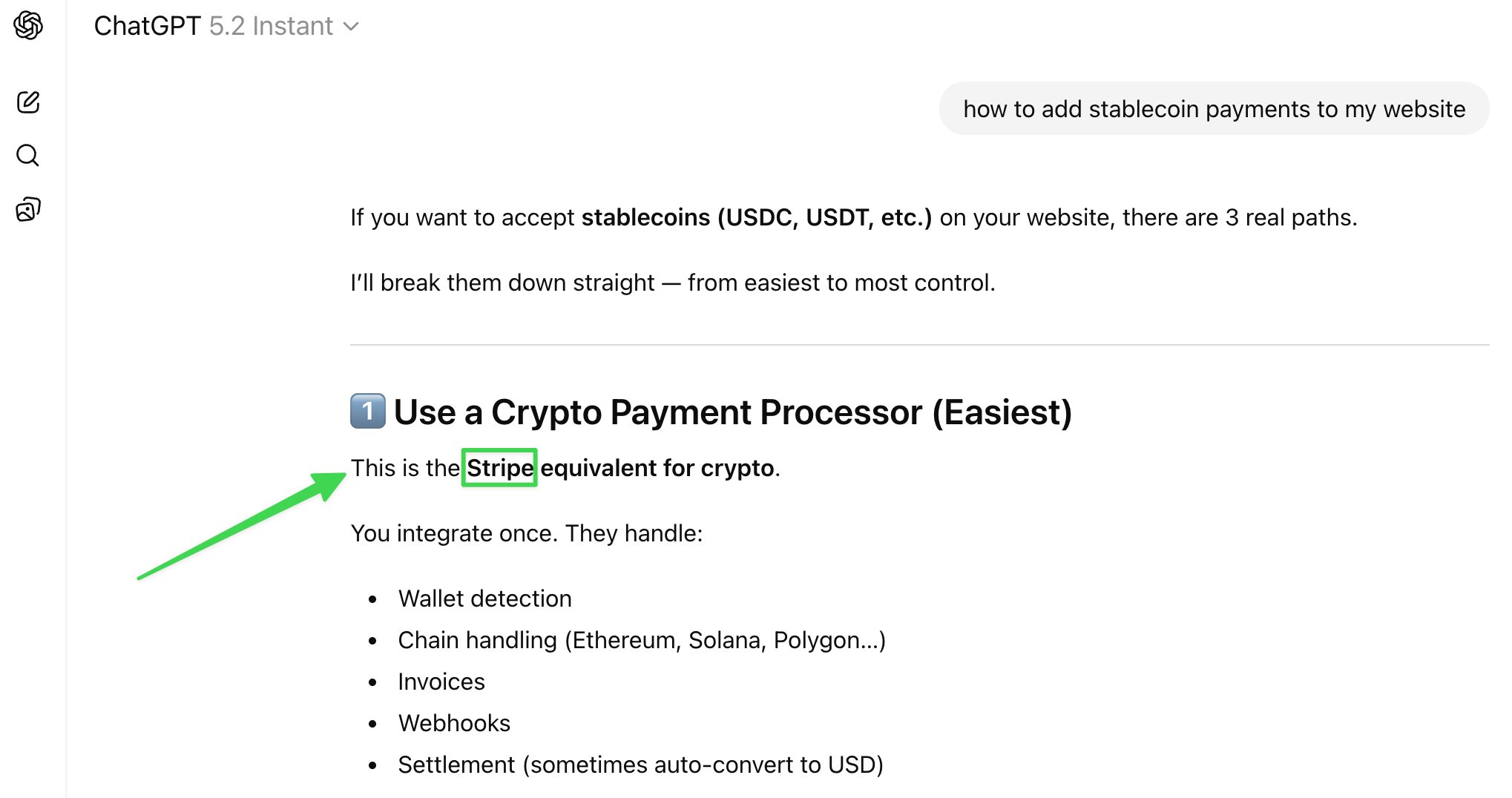
They make that possible by identifying the capabilities that companies are looking for, creating pages for them, and getting other people to talk about their product.
In some cases, they increase on-page engagement (which helps upranking) and signup conversion rates by adding an interactive playground:
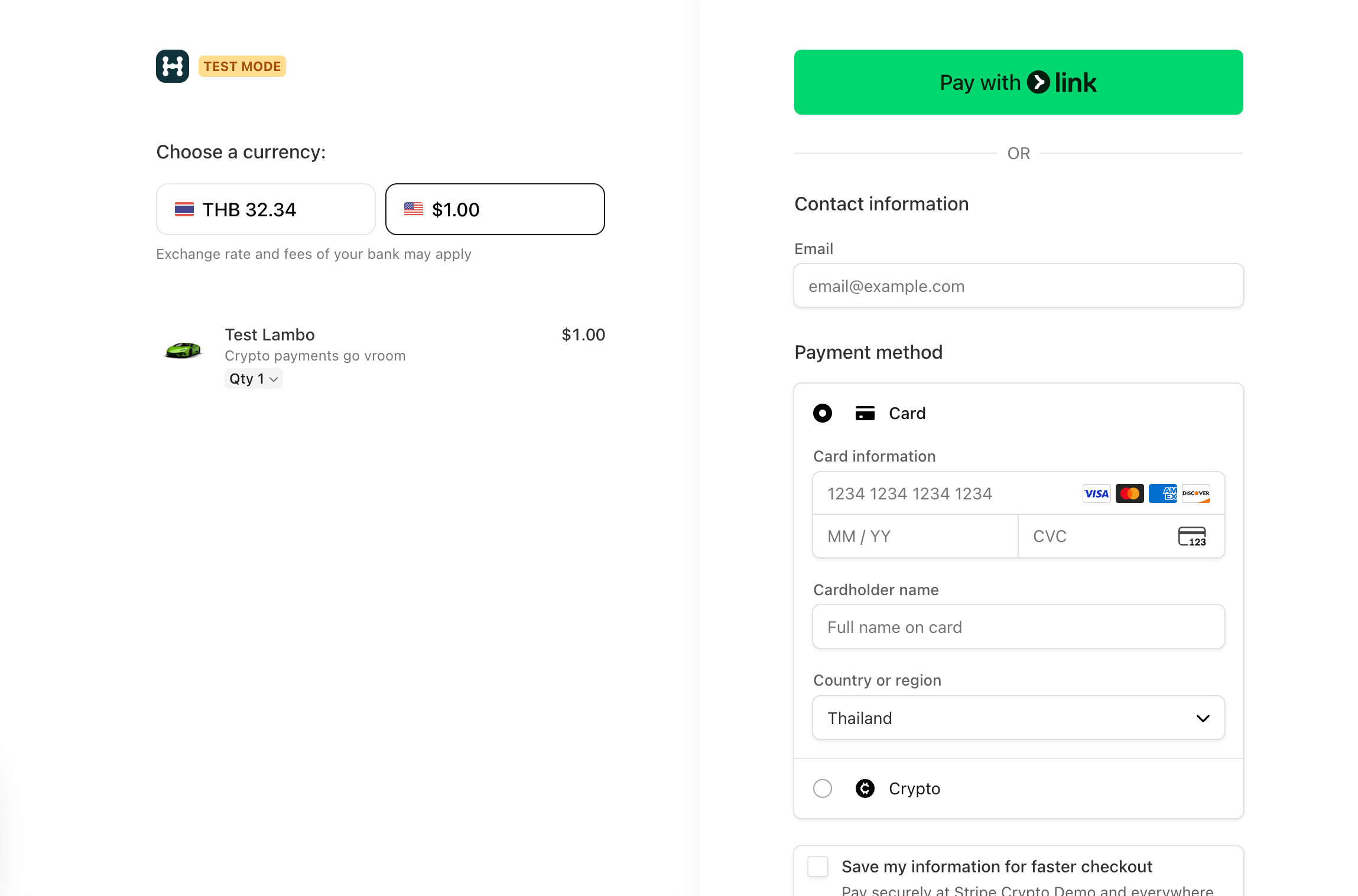
They're also masters in being useful before asking you for something in exchange. For instance, if you're looking for "high risk merchant list" or "fake credit card", they rank at the top.
Bright Data: Created a documentation page AND a GitHub README
Bright Data has a Python SDK on GitHub, and yet they also created a page about it on their official website.
Why this double work?
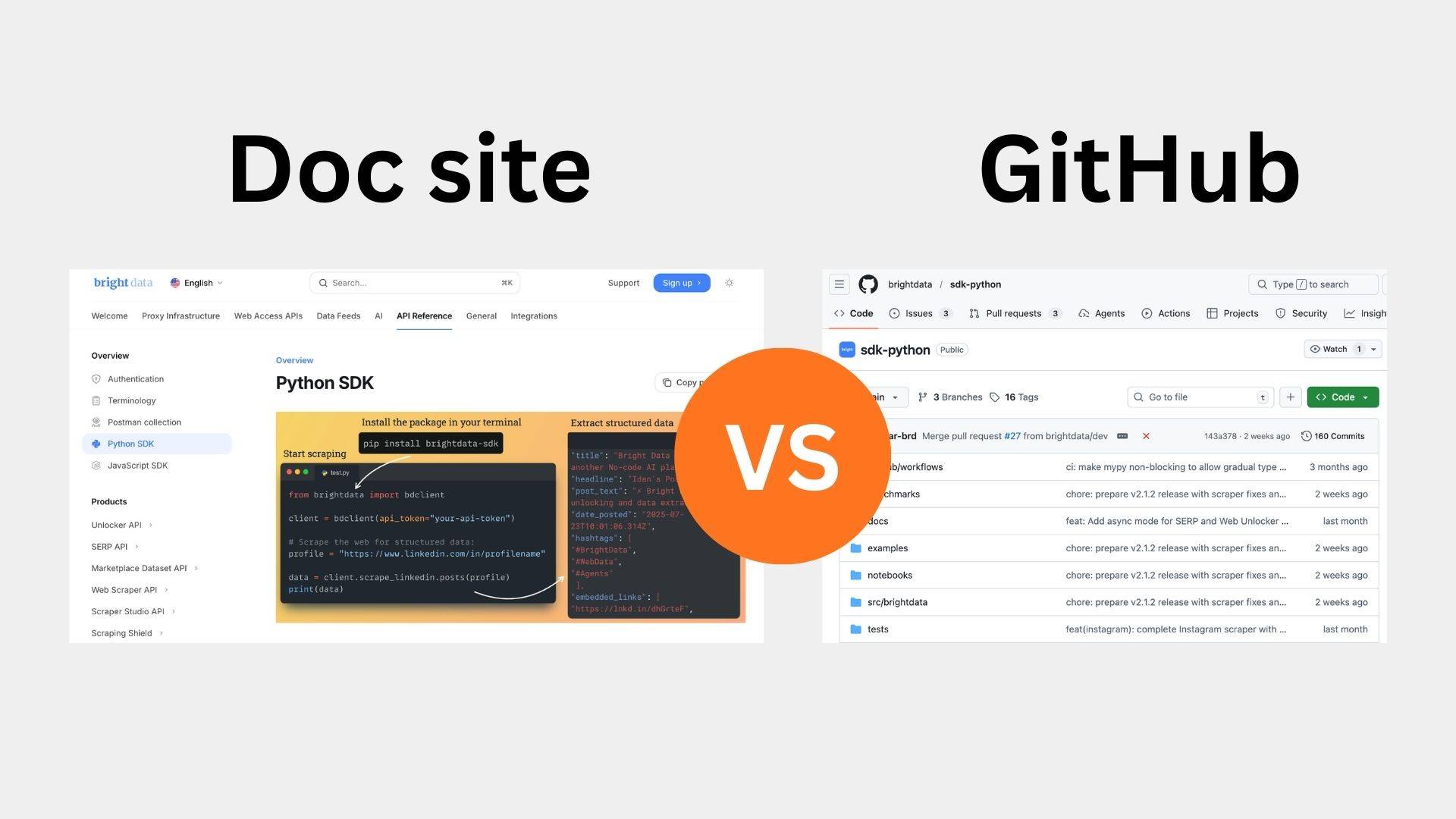
After all, wouldn't it have been easier to just link to the GitHub repository from their documentation site?
Good question.
Let me share with you their internal decision-making.
If you analyze their docs site's network requests (yes, this is how thorough we're at Nakora to make sure our clients win at every game they play), you'll see they load the LinkedIn Ads pixel:
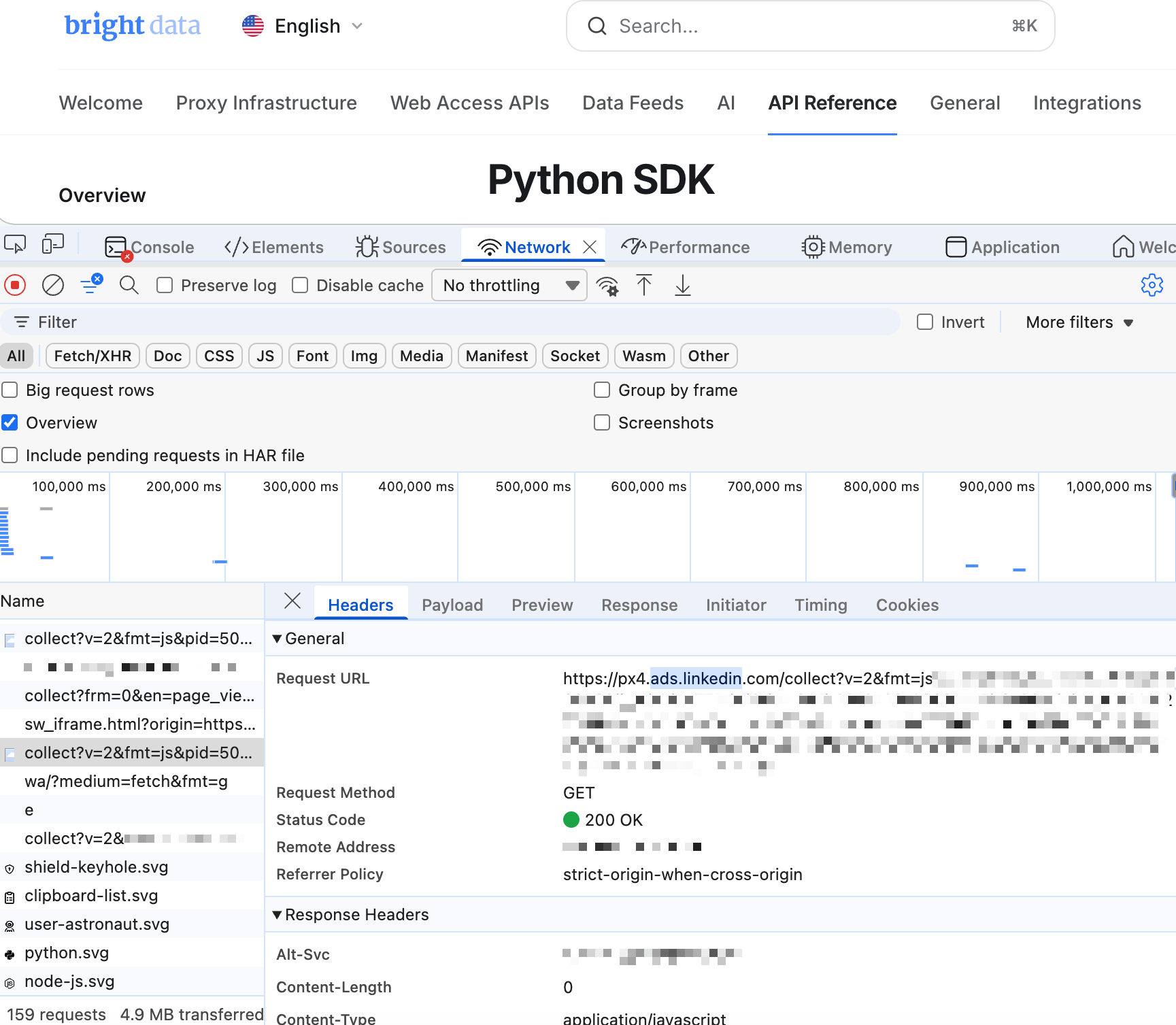
And they also load the Google Ads pixel. :)
What that means is they're tracking people who visit or engage with specific pages in their documentation to expand and improve the targeting for their Paid Ads strategy.
In other words: Bright Data's developer docs help their marketing efforts get more customers at a lower cost.
Allow me to say with business jargon: higher MRR, lower CAC, lower CPL.
You can't do that with a GitHub repo.
Also, many people default to searching instead of navigating (and this user trend is increasing). So having an internal page in your documentation helps the visitor find what they're looking for more easily. You prevent users from thinking "they don't have this feature" and leave forever.
And yet, a GitHub repo increases discoverability when developers search directly on GitHub, among other less intuitive benefits.
As you can see, for Bright Data, it's not about "being enough", but optimizing for the biggest results with cross-channel strategies. That helped them become a unicorn.
Check out our guide on GitHub SEO (the most complete on the internet, backed with data and examples) to learn more.
Axiom (browser automation): Should marketing pages and docs be paired together?
For most of my career, I've seen marketers taking care of commercial websites and blogs, and other teams owning the developer docs.
And then, you get marketers who don't understand developers, and documentation that's making you lose signups and customers.
But here's an example of a company that did it right: Axiom, a browser automation tool (API with a no-code option).
They created landing pages to attract people looking for solutions on Google and LLMs. For example, when you search for "automate web form filling", Axiom.ai appears in position #2 for their Automate Form Filling page.
At the same time, they created a doc page on How to Automate Web Forms, where they teach you how to solve your problem with their product.
Since those pages target different intents (product page vs. tutorial), and one is optimized for SEO while the other isn't, it's a great documentation SEO strategy to acquire and activate users. Also, it increases the perceived topical authority by search engines (i.e., how knowledgeable you're perceived about a topic for Google), which helps you uprank competitors.
And just like that, they applied the same playbook many times, even if happily it doesn't look obvious to regular visitors.
It's true that they could have published the article on their blog, but an advantage of using their docs is that it's easier to discover more capabilities thanks to the product-focused sidebar. Also, the analytics are simpler by default, and it's even easier to do segmentation in order to re-engage or upgrade users via email and social.
This is how Axiom.ai, a company that barely raised $250k, is likely crushing in revenue companies that are much better funded, such as Browser Use with $17M.
You might like to read how an API grew $1M ARR with SEO in just twelve months.
2Captcha, SerpApi: Developer documentation SEO through landing pages that feel like docs
This is what many technical marketers get wrong.
You shouldn't write a landing page for developers like you do in almost every other industry. Because, for example, this audience looks for proof for every claim instead of trusting the vendor.
Also, they look for the "how it works" and what tools it integrates with before even signing up.
Let's see a few examples of commercially successful pages.
First, let's have a look at 2Captcha's page on Amazon CAPTCHA API.
They show you how it works in code for multiple popular programming languages strongly associated with their use case. This is what you'd typically find on a documentation page.
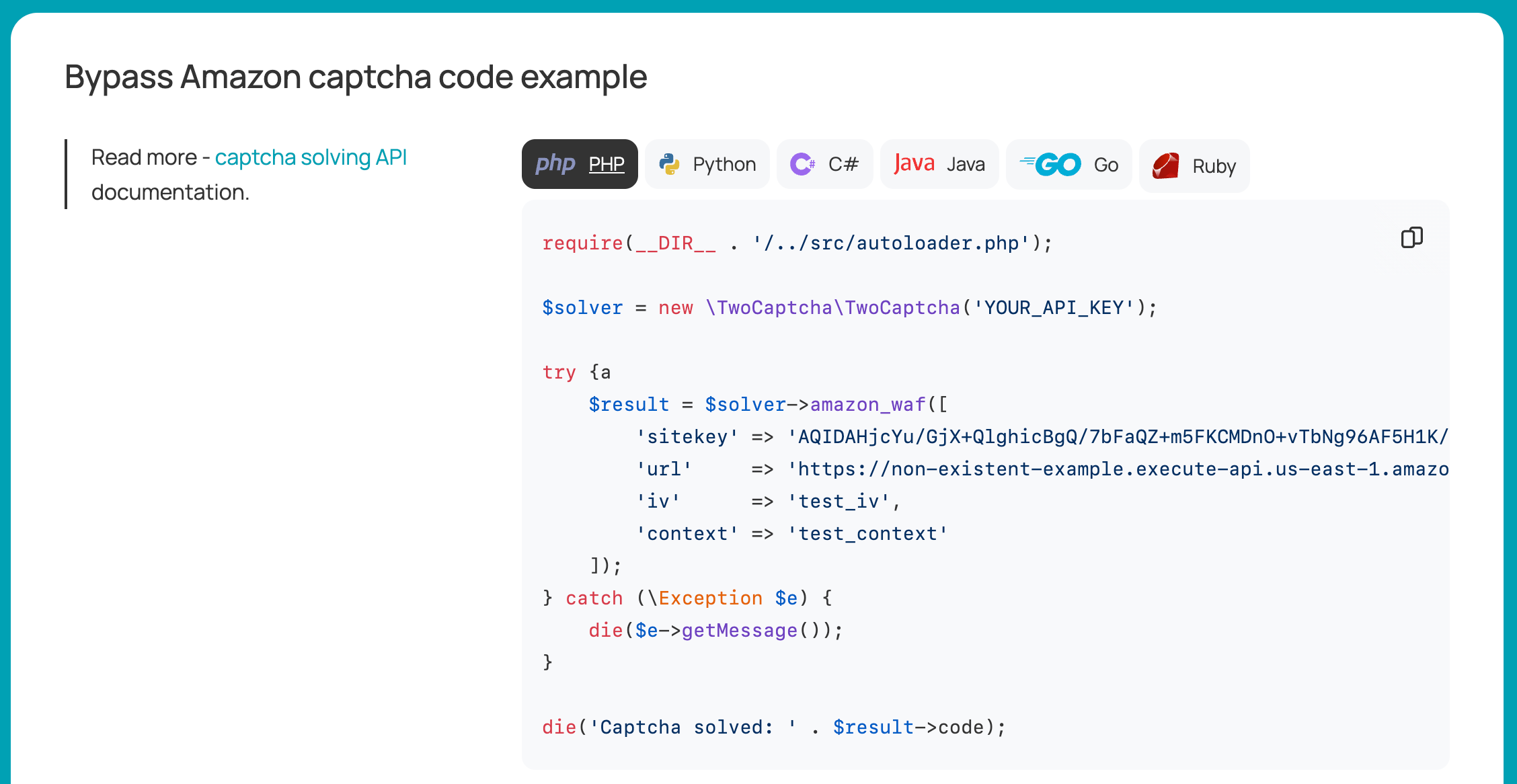
And you can see links to API docs, as well as upfront transparency on pricing and performance:

Another example is SerpApi's page on Google Maps API, where you see a long list of parameters as if it were a documentation page:
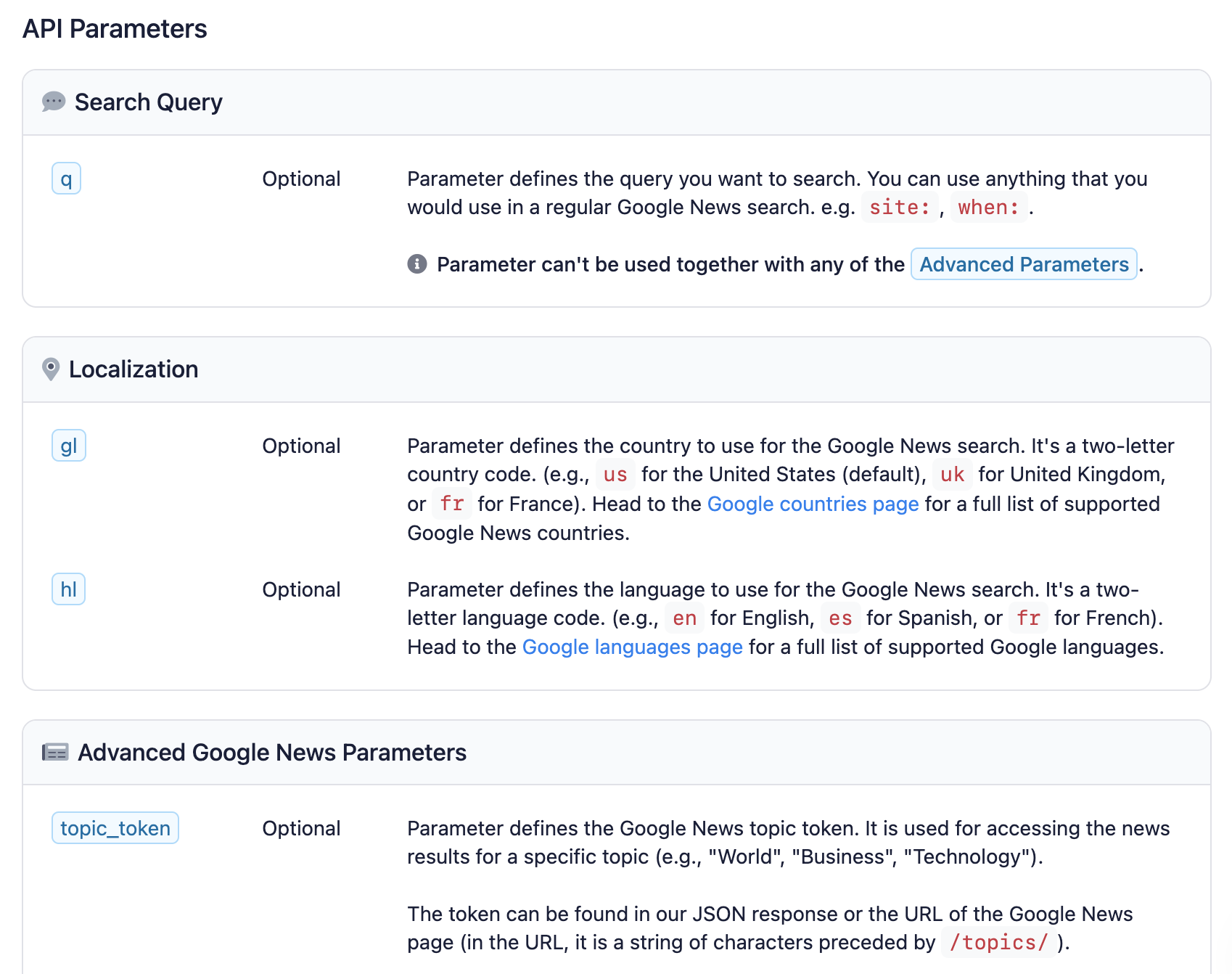
You can have a look at our guide on how to write a landing page for developers.
Firecrawl: Create open-source wrappers for common use cases
Developers don't want features for the sake of features. They want to get a job done.
This is Firecrawl's angle that motivated them to create open-source wrappers of their product, niched down to specific use cases, such as "lead enrichment" (passing names and emails, and obtaining a list with their company name, funding data, and so on).
After they had deployed several tools, such as Fire Enrich for the mentioned purpose, they created Use Case pages in their developer documentation. This is the respective doc page, and they got to rank #4 on Google for the keyword "lead enrichment", although they lost it recently.
Why is this page inside their docs hub? Essentially, because it helps developers find the answer to the question "Does this tool help me with what I'm trying to achieve?", as well as to get people inspired or increase use.
Supabase: Use documentation examples to rank for catchy searches
Creating Discord and Telegram bots is a top first idea among developers, and Supabase capitalized on it by publishing an example snippet page.
They topped it with a video tutorial, which ranks for several YouTube and Google searches, such as "create a discord bot".
However, written tutorials tend to perform much better than recipes for documentation SEO.
Conclusion
Doing SEO in the dev docs is very important for the developer journey, and much more versatile to increase your visibility (for PPC and ABM too) than many people would believe.
This article disclosed some real examples from devtool companies that most people don't know. We hope it's been useful to give you some ideas to grow the adoption for your developer product.
If you want help using your developer documentation as a growth channel, drop me a message on LinkedIn or schedule a strategy call.

Written by
AI SEO consultant, ChatGPT Ads expert and fractional GTM leader specializing in B2B SaaS, data, and AI startups. He has driven more than $12M across marketing, product, and sales, including over $8M through SEO, and has 8+ years of experience across content marketing, PPC, CRO, and more. He also co-founded a startup and has helped multiple companies reach successful exits.